Friday, August 23, 2013

Kildeer

Today is the 200th Anniversary of Alexander Wilson's death.

To be honest, a month ago I didn't know much about Alexander Wilson, but, in the last few weeks I have daily added to my knowledge about him (thanks largely to my hubby, Rick). I have even been to the cemetery where Wilson is buried (if you think a cemetery is not a very romantic place to spend time, let me tell you that before we were married Rick took me to a sewage pond--you birders will understand!)

At any rate, I have become increasingly fascinated by this young man who was a few years older than I when he died (and had achieved significantly more--I have some major catching up to do). Though he appears not to have appreciated Bloomfield, NJ, where he lived for a short while (and where we now live), I have to respect him for his talents--in particular I am impressed with his artistic depictions in American Ornithology.

But I was even more impressed (not necessarily positively) with his words about the Killdeer. I have a partiality for plovers--perhaps because years ago I saw a film adaptation of Brideshead Revisted and the one scene that has stayed in my head is when the protagonist talks about his mother having sent him plover's eggs to eat, a scene that made me feel I need to protect plovers from omnivorous humans.

Wilson offers two fascinating tidbits: one, "There [in South Carolina planters' yards] the negro boys frequently practise the barbarous mode of catching them [the killdeer] with a line, at the extremity of which is a crooked pin with a worm on it" American Ornithology, p. 158;

and two, "Their [killdeer] flesh is eaten by some, but is not in general esteem, though others say, that in the Fall, when they become very fat, it is excellent." (ibid)

The thought entered my head that killdeer are being treated as fish and that they have some affinity with Thanksgiving turkey. Two very strange things to learn about killdeer--they're treated as fish and could be eaten like turkey....


Sunday, August 8, 2010

Rallids


If you read my blog, you will no doubt know my predilection for large and stationary birds. Common Moorhen and American Coot, don't exactly fall into category, but they are usually fairly chunky (chunky enough to make some people eat them--at least the Coots, I'm not sure about the Moorhens) and slow-moving, if not quite immobile. As far as Rallids go, they're probably the easiest to see, which makes them my favourite among their closer relatives.

It's not too difficult to see the similarities between the two: both are gray-ish birds, both live in marshes, both have a similar body shape. Yet there are some differences that are worth noticing (just in case you're ever in a situation where immediate identification is not possible!). For example, their rear ends: the American Coot's rear end just slopes down (rather like a duck's) while the Common Moorhen's rear definitely points upward. Then their feet (which of course are hard to see) differ, too. While Coots have four lobed toes, green in color, Moorhens have very long toes, not lobed, yellow in color, and a little reminiscent of claws.

The more challenging distinction is of course between baby coots and baby grebes--but at the moment I lack a photo of a baby coot, so that entry will be coming up as soon as I get an appropriate shot....

Sunday, July 11, 2010

Skunked!


I have always had a soft spot for the more literary side of birding: years ago I remember learning that the former common name for Lark Bunting was White-winged Prairie Blackbird. As a beginner, I really relished bird names that incorporated a key visual aspect of a bird and thus I was particularly pleased with this name. Admittedly, it reflected only the male of the species, but as a neophyte I was only looking at males! I suppose I have 'progressed' in the sense that I now look more at shape, location and other non-color aspects of a bird, but I still enjoy hearing--and using--other English names for a particular species.

Thus, for example, while looking up this Surf Scoter in the second, revised editon of Peterson's A Field Guide to the Birds, I was happy to discover that it is sometimes referred to as 'Skunk-head Coot'. Apparently that is not a former name, it's just an appellation common enough in Peterson's time to merit inclusion in his guide. And it does reflect a key aspect of the male bird: his head is indeed "Black, with one or two white patches on the crown of head..." (Peterson, 50).

This individual was swimming around in mid April in English Bay, Vancouver and as I am now in the SW desert awaiting the monsoon, I am fantasizing and writing about ocean birds!. I did learn a little more: in the 1947 Peterson Guide, the entry below Surf Scoter is American Scoter (Oidemia nigra americana), a name that doesn't occur in Sibley. This got my research instincts flowing and with the help of my husband I now know that this 'American Scoter' was re-named Melanitta nigra sometime after 1957. Then, in 2005 the British Ornithologists' Union split this taxon into Melanitta nigra (Old World species), Common Scoter, and Melanitta americana (New World species), Black Scoter. So, as far as I can tell, there is no 'American Scoter' name anymore. I suppose none of this information is crucial to my enjoyment--or field identification--of the actual birds, but it is always interesting to me how much discussion and study is behind the names which provide many of us with a sense of satisfaction when we match them to the 'correct' bird.

Sunday, June 13, 2010

Thrush...


Any birder who identifies birds following the dictates set out in the field guides--shape, bill length, habitat, range--will immediately, naked eye, identify this one as an American Robin.  Fortunately, this is what I did this morning at Colony Farms, just east of Vancouver. 
However, when I took a closer look,  I have to admit I got to thinking.  Not questioning my identification, but rather marveling at how much pattern and color invite confusion into birding!  Without a doubt the bird has what I think of as a thrush-like posture: rather erect and 'tall'.  Its bill is appropriately-sized: neither too long for its head like Long-billed Curlew nor too short, like Bushtit!  The bird is where it's supposed to be--on a grassy lawn--and as American Robins are common throughout the area, its appearance is nothing out of the ordinary. 
But had I relied on the coloring of the bird I might have been thrown; based on that (and actually supported by the habitat), Fieldfare jumped to mind.  Also a thrush, Turdus pilaris is the same length.  Both birds also have a nice white supercilium.  Furthermore, like the bird pictured above, the Fieldfare is not uniformly colored on the breast--though it has streaks (i.e., the 'arrows' of the 'pilaris') rather than blotches.  The two thrushes have a similar stance. 

The telling difference, of course, is that I have just described an adult Fieldfare and the above American Robin is a recently-fledged one: he's still going to attain his uniform color.  Also, there's the helpful aid of range maps: Fieldfares do not occur with any regularity in the New World:  as the Nat Geo Complete Birds of North America notes they are a 'casual vagrant in northeastern North America'; 'accidental to Ontario and Minnesota'; and 'casual in western Alaska'.  Still, there's always a first time...

Saturday, May 22, 2010

Black, White and Red all over...


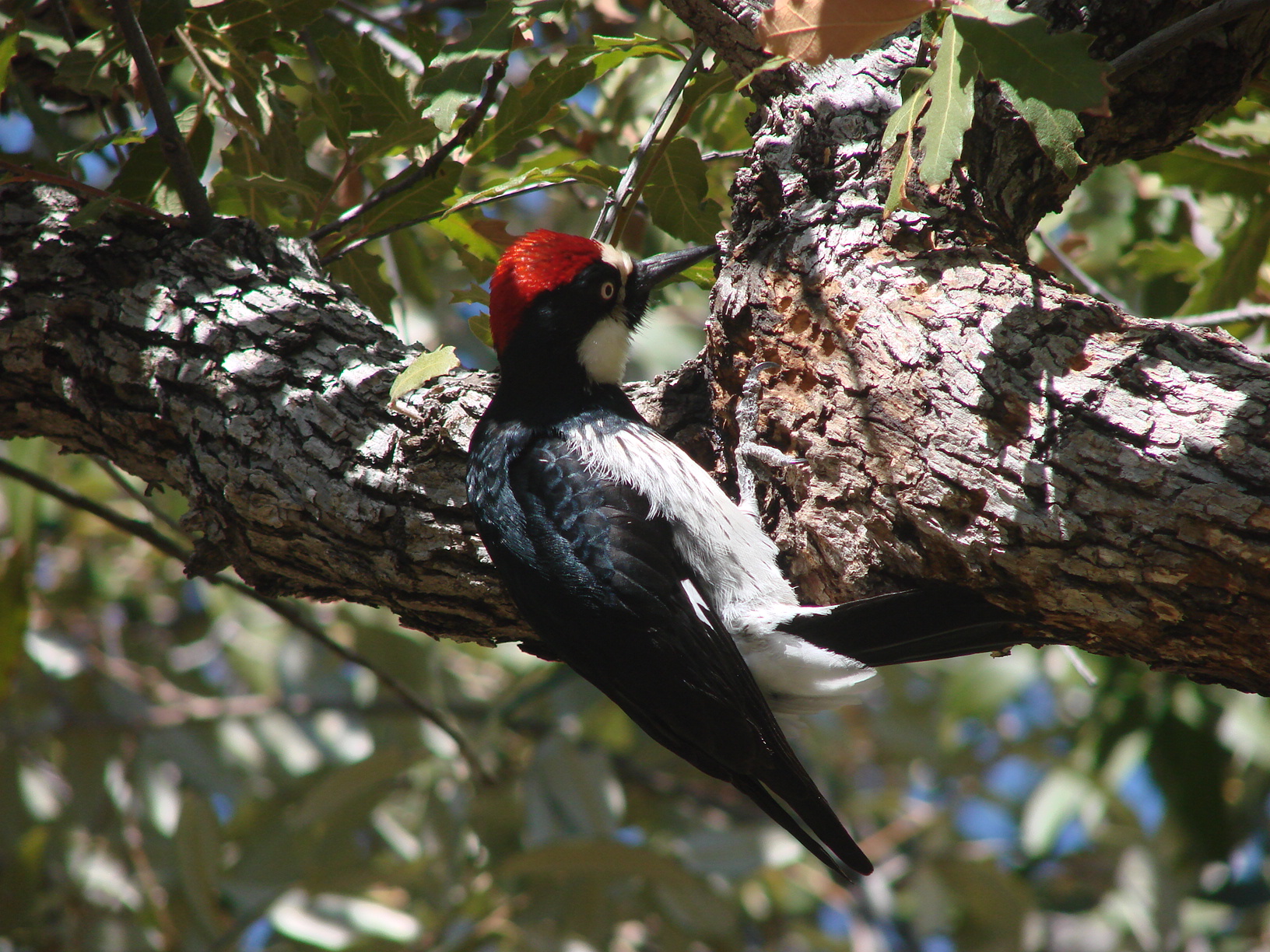
When I started birding my criteria for a 'good' bird were size and immobility--that is to say that I appreciated herons most and warblers least! I have since broadened my perspective and actually enjoy the challenge of finding and identifying numerous warblers. But that still doesn't diminish my joy at easily identifiable birds, and I would have to say the Acorn Woodpecker is one of those.

It's not exactly stationary nor is it particularly big, but its block-like division into black, white and red makes it a hard bird to misidentify in the West (were I in the East, I'd have to at least consider its relatively close relative, Red-Headed Woodpecker, which has even more stringent color blocks, but this is where those range maps in all the field guides come in handy!) To me, Acorn Woodpeckers always look a bit clown-like--maybe that's partly due to their call that seems to say 'wake-up! wake-up! wake-up!'  Or maybe it's the fact that they're so social and are constantly chasing each other around, making me laugh at them.

I think of them as an Arizona bird--but that's just because I've seen them there.  When I read up on them in the Nat Geo's Complete Birds of North America, I found that they are accidental in BC.  This gives me hope that I'll see one in my native land!

Saturday, May 15, 2010

Spotted Towhee


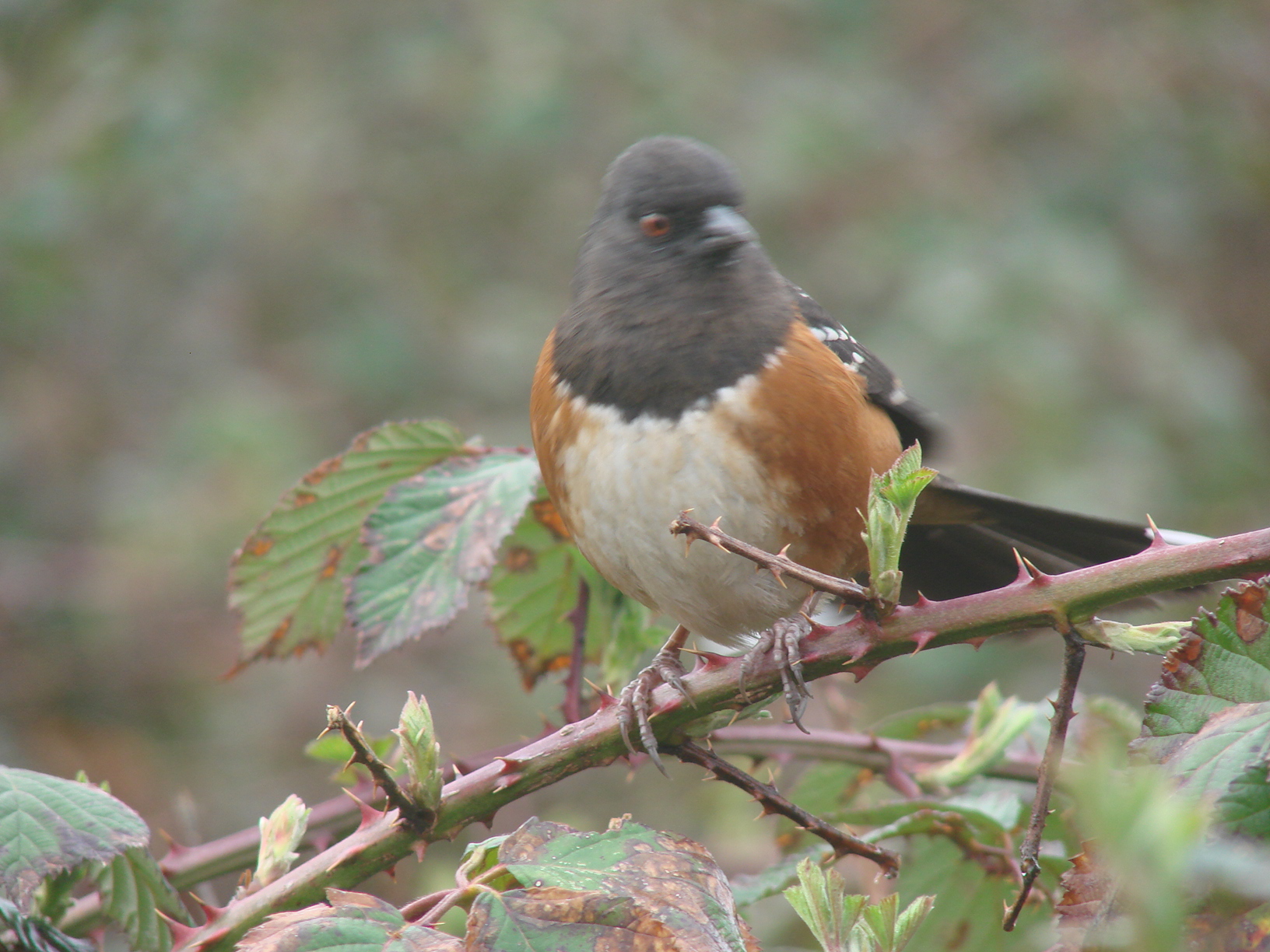
There are many things I love about my 'home and native land'--the way people so many people call out thank you on the bus here in Vancouver comes to mind--but probably one of the best things is that I have a 90% chance of seeing one of a pair of these beauties on my short walk from bus to office in the morning.  There's a hedge just outside my building and invariably a towhee is hopping around in there.  Given the fairly obvious difference in head color (females are brown, males glossy black), I feel quite confident in identifying which of the pair I am seeing.  I keep hoping to see some streaky babies...I can't imagine a better addition to my Towhee sightings!

Unlike most of the birds that pose protracted identification challenges for me, the Spotted Towhee is really quite easy--especially for a sparrow (think of distinguishing Cassin's and Botteri's.... or the various subspecies groups of Dark-eyed Juncos).  Even in flight, Spotted Towhees are recognizable by their big white tail spots, visible from afar.

Their call could potentially be confused with that of the Catbird, but because the latter are very rare here on the West Coast, I assume Spotted Towhee unless proven otherwise (I suppose that is a sign that I am no longer quite a beginner--I have lost the conviction that I am seeing something incredibly rare every day!).

Maybe the ease with which I can identify Spotted Towhees is the true source of my partiality for this large sparrow, but I like to think that it's more due to the bird's good looks and the attention it pays me at the beginning of my day.

Tuesday, May 4, 2010

My Vote for the National Bird of Canada


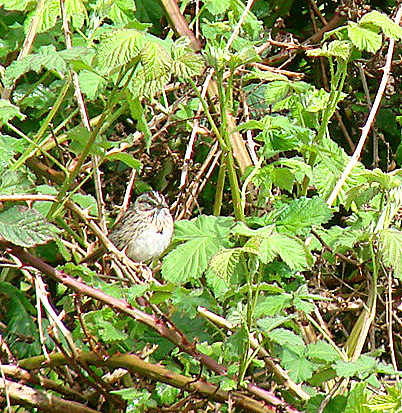
Lincoln's Sparrow was first described in CANADA: in Labrador by Audubon and named for a CANADIAN, Tom Lincoln. Apart from being the most beautiful sparrow in my opinion, Lincoln's is found in all the CANADIAN provinces and territories. Though initially people might hesitate to choose a sparrow as a national bird, Lincoln's Sparrow's distinctive features and beautiful song will, I am sure, encourage people to make the effort to learn one more bird.

Red-tailed Hawk--the current frontrunner--would be a disappointment as the bird for CANADA. It was first described in Jamaica and its scientific name, Buteo jamaicensis, reflects that.

You can add your voice in favor of Lincoln's Sparrow by clicking here.

Saturday, May 1, 2010

Ring-billed Gull


Gulls have always been tricky for me--it seems that they have more plumages than other birds (first/second/third year; juvenile, adult, breeding/non-breeding...) and, frankly, too many of them are white, black and shades of grey.  Heermann's Gull is probably my favourite simply because I have seen them only in breeding plumage when their bills are so red that you can't mistake them for any other gull.
I was pretty good at distinguishing Ring-billed and Herring Gull, too, as they were the ones I saw most in New Jersey.  They were frequently in mixed flocks and  I learned to distinguish them by size comparison (though I admit that I also used leg color despite my usual prejudice against color as an identification criterion).  The Herring Gulls were reliably larger than than the Ring-billeds, in fact they were generally the largest gull around.  Now, however I find myself with a new set of gulls: both Herring and Ring-billed Gulls are not our 'local' species anymore (though they do occur).  You can understand my joy, then, when the other day I saw this fellow--and immediately welcomed it as a long lost friend.  Sadly, this individual is probably not long for this world--he was definitely weak and sickly which allowed my husband to get to close with the camera--but nonetheless, he had the yellowish legs, the ring on the bill and--joy, oh bliss, I discovered that Ring-billed can maintain its position of 'smaller' gull when I compare it to our current local resident: Glaucous-winged Gull.  So, by default, Ring-billed has started me on the way to learning another gull...

Saturday, April 10, 2010

Northern Shrikes

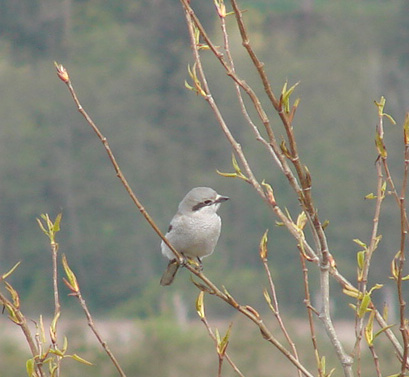
Just when  I thought I'd safely categorized Shrike--versus Northern Mockingbird--I find that I am in the range of Northern Shrike instead of Loggerhead and they're not the same!  At home in Tucson, we're in the range of Loggerhead Shrike--only--but now that we have crossed the international border to the north, we are in the land of Northern Shrike and my learning has to expand, eh?
On a first glance the two Shrikes are pretty similar--and I may be forgiven for enthusiastically calling "Loggerhead" upon our arrival in BC.  The silence from my driving companion--a veteran birder of thirty-five years--assured me that I had made a mistake.  I looked again (in fact I turned around and stopped the car) and observed the bird more closely, that is I stared at the head.  The head appeared to be rounder than usual and the eye mask was rather limited--projecting only behind the eye and not extending across the forehead.  Also, this bird had a white forehead where the Loggerhead has a black one--a distinctive feature, IF you can see it.
So, it's not much to go on--both Shrikes perch in similar locations and both sound--at least to me--similar, but if you pull over and gaze next time you're in the presence of a Shrike, the chances are you'll get it down to species as long as you're in Arizona or British Columbia, and as long as you're not witnessing the first record of Brown Shrike in BC!

Saturday, April 3, 2010

Shrike, are you mocking me?


When I get a nice, up close look at a Loggerhead Shrike such as this one I simply enjoy the view--and am grateful that I am not a lizard, rodent, bug...you get the picture. But when I see said Shrike from a distance, I find it rather easy to be mislead into believing that I am seeing a Northern Mockingbird. Color and pattern are similar--grey with a white wing patch; perch location is similar--tops of trees; and topography is similar--open fields. (Shrikes do appear in urban settings, but far less frequently than Northern Mockingbirds, so I am usually pretty careful before claiming to have seen one in the city).

With experience--and magnification--they really aren't all that similar. Their Gestalt is in fact rather different. While the Northern Mockingbird (and yes, there are southern Mockingbirds--but none are called Southern Mockingbird) is long and slender, the Loggerhead Shrike is long and rather rectangular. In addition, Shrikes in general have large, fat heads while Northern Mockingbirds have rather flatter, smaller ones (all this in comparison to their respective body sizes). The bill shapes, too, continue this distinction as the Shrikes have rather fat, hooked bills while the Northern Mockingbirds have slimmer, thrush-like ones. Lastly, their calls differ: the Loggerhead Shrike has a buzzy one while the Northern Mockingbird sounds more like a 'chack' 'chack'. Most helpful, however, is their song: while the Shrike has a repetitive, buzzy note, the Northern Mockingbird indulges in a wide variety of songs--from mimicking car alarms, to alarm clocks, to mourning doves...you can pretty much count on the fact that if you hear a 'weird' song, you're listening to a Northern Mockingbird. Now a real challenge would be an urban Shrike being imitated by a nearby Northern Mockingbird....I'll post that if it ever happens!

Thursday, March 18, 2010

American Kestrel


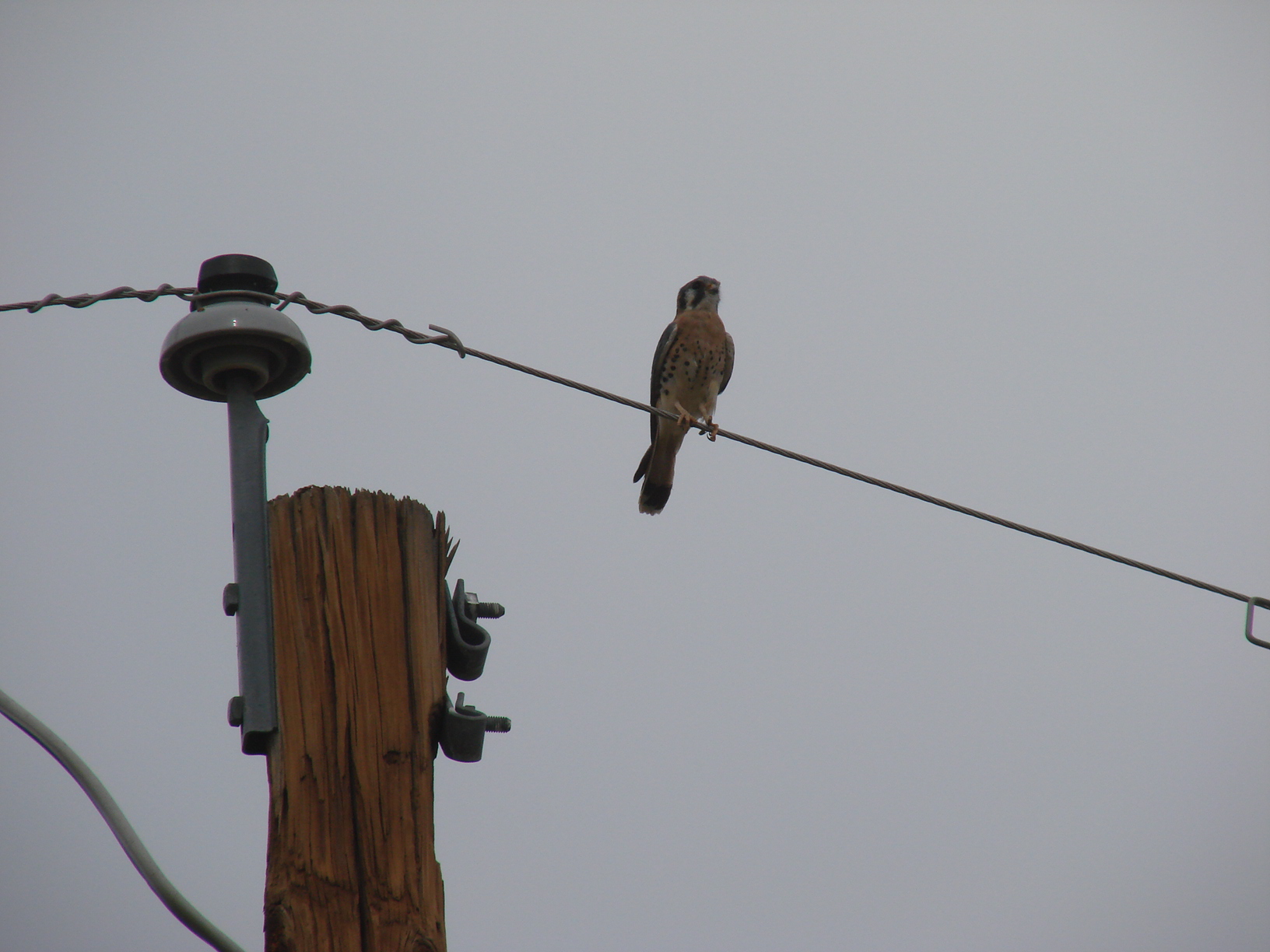
I'm not really quite sure what 'home' is -- as a Canadian, I feel that I've come home in moving back to Canada; yet, on the other hand, my house is south of the border--in the land of American Kestrels.  Well, we do get American Kestrels here on the Vancouver Coast--and no, my patriotism does not extend to re-naming them Canadian Kestrels--but they are much farther and fewer between.  I generally see these smallest of the falcons of the US and Canada when I am at my US home--they tend to perch on the telephone wires just like the one above.  In my experience, I have found the females are usually visibly bigger than the males, though on checking my observations in the Nat Geo Complete, I find that the sexes are of a similar size.  But then again, comparative size only works when you have two birds of opposite sex!  Therefore I have had to learn the other distinctions between male and female. The most obvious is color, of course--the males have blue wings while the females have brown ones, but one can't always see the wings (or the light's bad...).  The difference in chest pattern (spots for the male, streaks for the female) is the distinction I find most reliable, as it's frequently easily seen from a distance.  In addition, it's easy to remember as the female also streaks, or rather bars, on the tail, while the male just has the tail band.  All these differences mean that 9/10 times I can sex the bird correctly and quickly--now I just have to get more of them to fly up north so I can keep my eye in.

Monday, February 22, 2010

The Juncos, aka The Birds


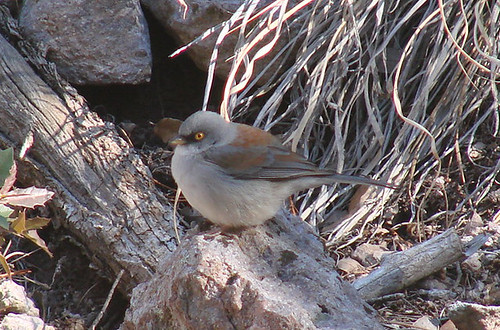
I have always thought that Hitchcock cannot have been very familiar with Yellow-eyed Juncos, for surely they inspire more fear than crows do. Their psychotic yellow eyes gleam out at you, and despite the bird's overall small size, I always get a shiver.

So sometimes I try to ignore the eyes and focus on the rest of the bird in order to identify it (and save myself from shivering).  Typical of the Yellow-eyed Junco is of course the red back that spills over into the wing coverts and tertials, distinguishing this species from the Red-backed and Gray-headed subspecies of the Dark-eyed Junco. In addition, the Yellow-eyed has a high-pitched, thin call with a rich, varied song--while the Dark-eyeds seem to sound more robust  in their calls but not as complex in their songs.

Lastly, I go by how tired I am from the hike!  If I am really tired and have attained great heights, I suspect that I am in Yellow-eyed range, whereas if I am still fresh then I conclude that I am more likely to be in Dark-eyed range.

At the moment I'm living in Vancouver, and thus I am far out of Yellow-eyed Junco range and don't need to fear that they'll flock my house and go for my eyes....

Monday, January 4, 2010

Icterids


Happy 2010!  It's been a while since I have written my blog--the reason is I moved twice across the continent within 2 months: first, from Arizona to New Jersey; then from New Jersey to Vancouver (via Arizona!).  All  of this has meant no time for birding or blogging, especially given that I have had erratic internet access.
You can appreciate, then, how fitting I found the two birds above--spied on one of my too-rare days at home in Tucson.  In the foreground, the two female Red-winged Blackbirds represent a species that lives in all my recent state and provincial domiciles.  Though the female of this species often tricks birders into thinking they're seeing some type of sparrow, the sure-fire way to identify them is the thicker bill shape, the pale, obvious supercilium, and the call that sounds like a rubber band being pulled while the bird simultaneously flicks its tail.  Then of course there's the size, though I often find size a tricky thing to judge when I am looking through binoculars.
In the background is a Brewer's Blackbird, which is rather rare in New Jersey but, according to Keith Taylor's British Columbia BFG, a permanent and common resident in coastal BC (our latest home-away-from-home).  Identifying this one was a little trickier as the female bird doesn't have a particularly distinctive plumage.  But that is precisely what made me think of Brewer's Blackbird.  And the dark eye checked out, too. 
Looking forward to having some time to explore our new area; I'll definitely be learning new gull species!

Saturday, November 28, 2009

Red-naped/Red-breasted/Yellow-bellied....

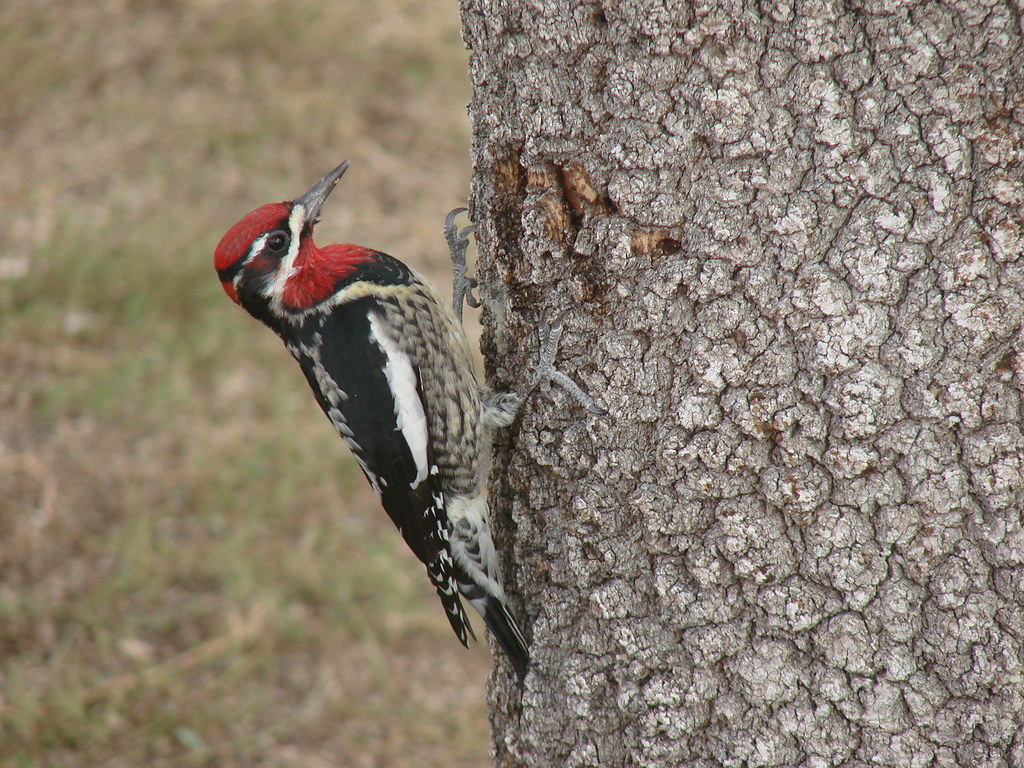
...sapsuckers.  All three used to be lumped as the single species Yellow-bellied Sapsucker.  A  couple of decades ago, the AOU Committee decided to split this bird based on genetic evidence.  Typically, it's relatively easy in the field to distinguish the current three species: the throat pattern of the Red-naped, with its red throat that bleeds through the black lateral throat stripe; the extensive red on the head and breast of the Red-breasted, and the plain nape and irregularly mottled back of the Yellow-bellied.  In addition, of course, range maps will help.  But more and more sapsuckers are showing up out of range and showing intermediate plumages.

All of this makes me wonder whether we shouldn't stop trying to identify weird-looking sapsuckers in the field and instead take inspiration from the old species epithet of the combined Yellow-bellied group: varius.


Saturday, November 21, 2009

Northern Mockingbird


Years ago waking up early one of the first mornings I lived in graduate student housing, I was shocked and stunned to hear a fellow resident's alarm clock persistently ringing.  Was everyone getting up this early--to bird?  I dressed and got ready to leave for my early walk, still hearing the alarm clock.  Oddly, it got louder and louder the closer I got to the outdoors. Only once I was outside and heading towards the woods did I realize my mistake.  No fellow grad student was in sight--but a Northern Mockingbird was perched on a wire opposite my flat and he was singing--or rather ringing--away.

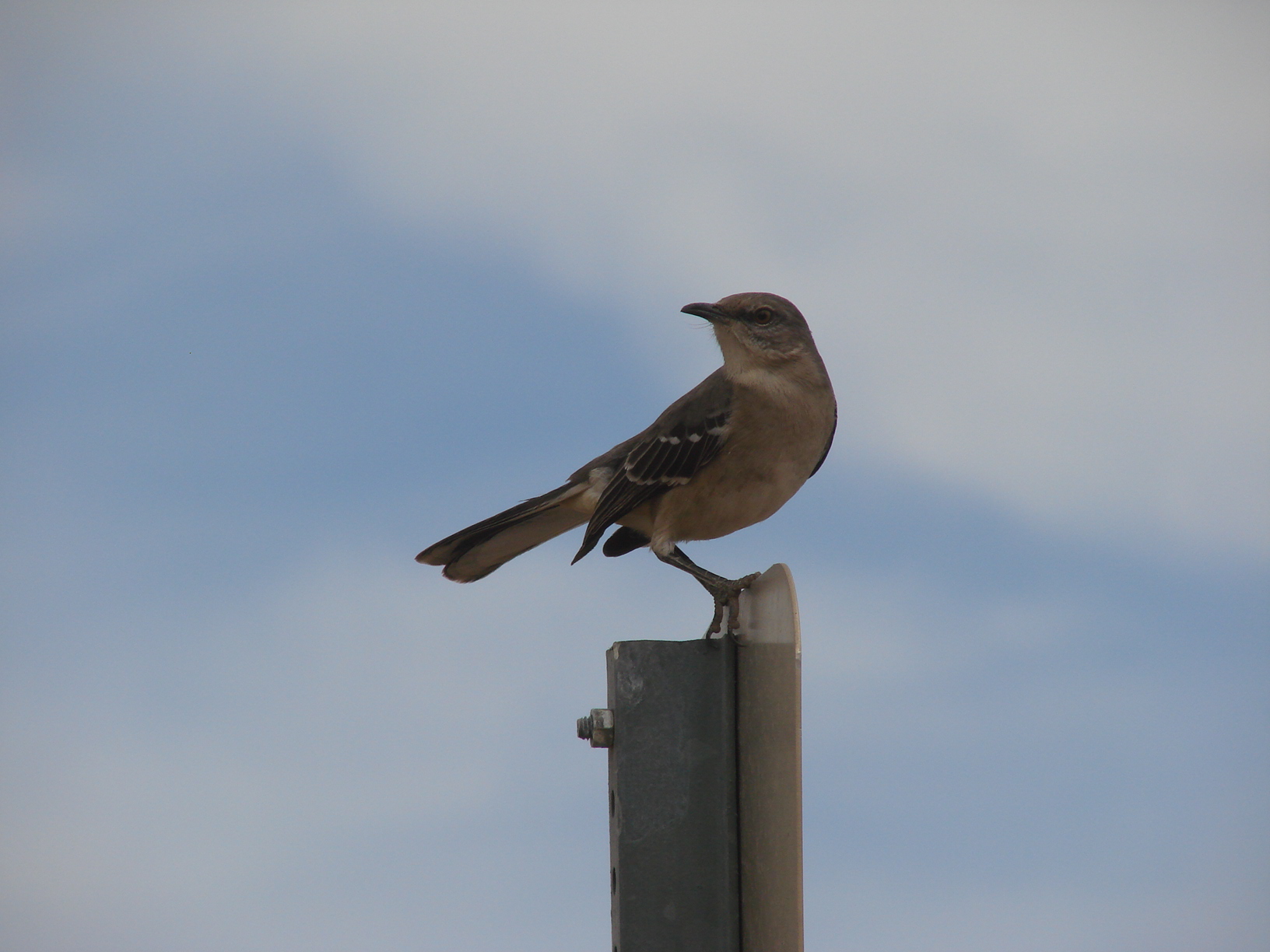
In the intervening years, I have learned that one of the most reliable ways to identify Northern Mockingbirds is, in fact, by their sounds.  If you keep hearing car alarms, alarm clocks, cooking sounds (I'm not kidding) as well as several different birds one after another, the chances are that you're in the presence of a Northern Mockingbird. The classic field marks, of course, are the white patches in the primaries and in the tail, but if the bird is perched (most of the time, in my experience!), you can't see these identification marks.

Perched, usually on top of bushes, the Northern Mockingbirds have a good long tail, a small head, a fairly short and thrush-like bill, and an overall slender look (though they can puff themselves up causing them to look much fatter than they are).  Usually, you can also see the two white wing bars.  In posture they tend to be more horizontal than vertical, and they look alert (rather than sleepy)--probably due to their long legs, though possibly also because they are always on the lookout for their next source of mockery.

Saturday, November 14, 2009

Ugly Duckling


I've always liked the story of the Ugly Duckling.  Maybe it's because I have High School memories of the popular girls or maybe it's because I am ever hopeful that at some point I'll answer that age-old question:  who am I, really?  But at any rate, I have a soft spot for those duck(lings) that many birders ignore or--worse still in my opinion--describe as 'trash birds'.  And Mallards fall among them.

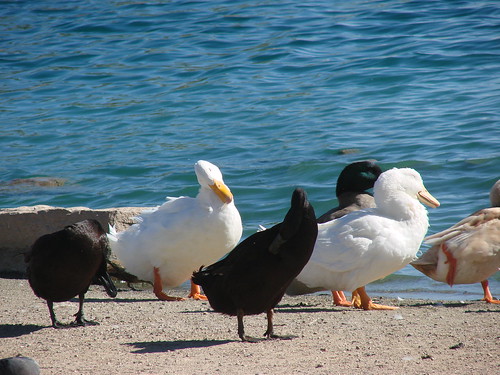
Your classic Drake Mallard in breeding plumage is very easy to identify: its glossy green head, smart white neckline and chocolate-colored breast is unmistakable.  Likewise, the female in breeding plumage has some telltale signs, notably the orange bill with the black center. But there are many Domestic Mallards and they can range in color from pure white to dark black with practically everything in between.  They're usually easy to spot: big, clunky ducks, usually with orange/yellow/green bills.  But I learned a trick to sex these Domestic Mallards:  the breeding males will have the curly-q  feathers at the end of their tales, as seen on the second black Mallard in the picture.  Most people won't look twice at a Mallard, let alone a Domestic one.  But actually, these birds deserve a second glance--just like the Ugly Duckling.

Saturday, November 7, 2009

Fancy Pigeons


To a non-birder the word pigeon generally conjures up images of a multi-colored bird pecking for crumbs in major urban centers: St. Paul's Cathedral in London comes to mind, or the downtown areas of New York.  To a birder those pigeons are Columba livia, aka Rock Doves (or, to really up-to-date birders following the supplements to the AOU checklist Rock Pigeons as of 2003).  But there are many other birds in the Columbidae family; in English they sometimes are called doves, at other times pigeons.

Two of my favourites are Mourning Dove and White-winged Dove (see picture above).  Like the Rock Pigeons, these two are pretty common sights in urban Tucson.  In some ways, I think they're pretty similar: as evidenced by my photo, they choose the same perches, in posture they are both fairly upright and they both have tails that extend far below the wing tips.  Of course, there is the obvious size difference, very obligingly projected by these two birds as they perched next to one another, as well as the clear white wing patches which provide a nice white edge when the White-winged Dove has its wings folded.  But sometimes, you don't get two birds together nor do you get a profile view.

If you're lucky enough to hear the bird you'll easily be able to distinguish the Mourning Dove's slower, really melancholic song from the White-winged's owl-like call.  But what works for me every time is looking more closely at the tail: while both birds have long tails, the Mourning Dove's tail is sharply pointed, a characteristic you can see from any angle.  In contrast, the White-winged Dove's tail is really quite blocky.  If you glimpse the tail from underneath you'll of course also see the dark tail band.  Either bird is really quite beautiful--as are Rock Pigeons--and deserves some appreciation.  All three of these birds are shot in the States, but I prefer to shoot them with the camera.

Sunday, October 11, 2009

Grail Bird?


My husband just came back from Mexico today (the ABA conference in Veracruz) and as soon as he was unpacked (and the laundry machine was going), I eagerly began to examine his photos.  Beautiful, striking birds  appeared before me on the screen. And then along came this bird.  Given the context--exotic birds my spouse got to see and I didn't--and the bird's general shape, especially the cut-off rear end, my initial reaction was "ah, some species of rail that I don't know."  (In my defense the preceding picture was of Gray-necked Woodrail--so I clearly had rails on the brain).  Fortunately, I quickly realized that in fact this was one of my old friends: Great-tailed Grackle, missing its tail feathers.  The eye, too, of course is pale and the bill just doesn't fit a Rail bill.  If I'd been paying better attention, I would have realized that the habitat was more typical of a Grackle than a Rail, too--mowed lawn and concrete.  I know what a Grackle looks like and what a Rail looks like, but thinking about Mexico and expecting something exotic, I merged the two and came up with that centuries old treasure: the Grail -- in bird form, of course!

Saturday, October 3, 2009

How Old are You?


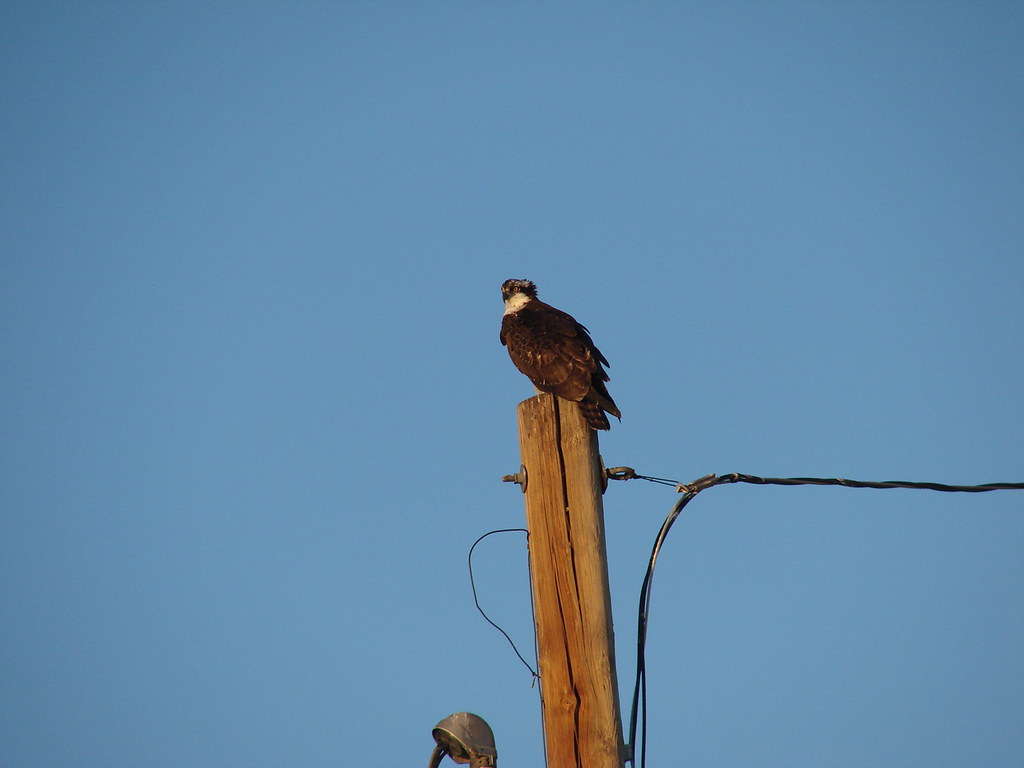
I can now generally identify an Osprey when I see one, though in my earlier years I called plenty of Bald Eagles Ospreys.  There is no rest for the wicked, however, and now I constantly find myself trying to determine the age of the sighted Osprey.


At first study (with binoculars), I looked at the eye color and thought that because the eye was yellowish, this would be an adult (juveniles have orange eyes).  But skeptical as I am of using color as my only identification tool--and because eye color gradually changes over the autumn--I turned to the pattern of the bird.  Juveniles, according to Wheeler, have white tips to all the feathers which gradually wear off as the bird ages.  My bird has a few white tips to go with the yellowish eyes, so it seems to me I have an old juvenile bird.

Still not quite sure, I looked into the migration timing of Ospreys.  It turns out that adults and juveniles don't migrate together; adults leave earlier (beginning in late August and early September), while juveniles are on the road (or the telephone pole) later in the month.  I saw this bird in Utah at the end of September.  That timing supports the 'old juvenile' status I have bestowed on this bird.

I'm never quite sure of age--birds, like people, seem to enjoy hiding their real age.  However, my best guess for this one would be that this white-tipped, yellowish-eyed bird (I haven't mastered sexing Ospreys yet) was on its first migration and thus would be an old juvenile.