Sunday, June 13, 2010

Thrush...


Any birder who identifies birds following the dictates set out in the field guides--shape, bill length, habitat, range--will immediately, naked eye, identify this one as an American Robin.  Fortunately, this is what I did this morning at Colony Farms, just east of Vancouver. 
However, when I took a closer look,  I have to admit I got to thinking.  Not questioning my identification, but rather marveling at how much pattern and color invite confusion into birding!  Without a doubt the bird has what I think of as a thrush-like posture: rather erect and 'tall'.  Its bill is appropriately-sized: neither too long for its head like Long-billed Curlew nor too short, like Bushtit!  The bird is where it's supposed to be--on a grassy lawn--and as American Robins are common throughout the area, its appearance is nothing out of the ordinary. 
But had I relied on the coloring of the bird I might have been thrown; based on that (and actually supported by the habitat), Fieldfare jumped to mind.  Also a thrush, Turdus pilaris is the same length.  Both birds also have a nice white supercilium.  Furthermore, like the bird pictured above, the Fieldfare is not uniformly colored on the breast--though it has streaks (i.e., the 'arrows' of the 'pilaris') rather than blotches.  The two thrushes have a similar stance. 

The telling difference, of course, is that I have just described an adult Fieldfare and the above American Robin is a recently-fledged one: he's still going to attain his uniform color.  Also, there's the helpful aid of range maps: Fieldfares do not occur with any regularity in the New World:  as the Nat Geo Complete Birds of North America notes they are a 'casual vagrant in northeastern North America'; 'accidental to Ontario and Minnesota'; and 'casual in western Alaska'.  Still, there's always a first time...

Saturday, May 22, 2010

Black, White and Red all over...


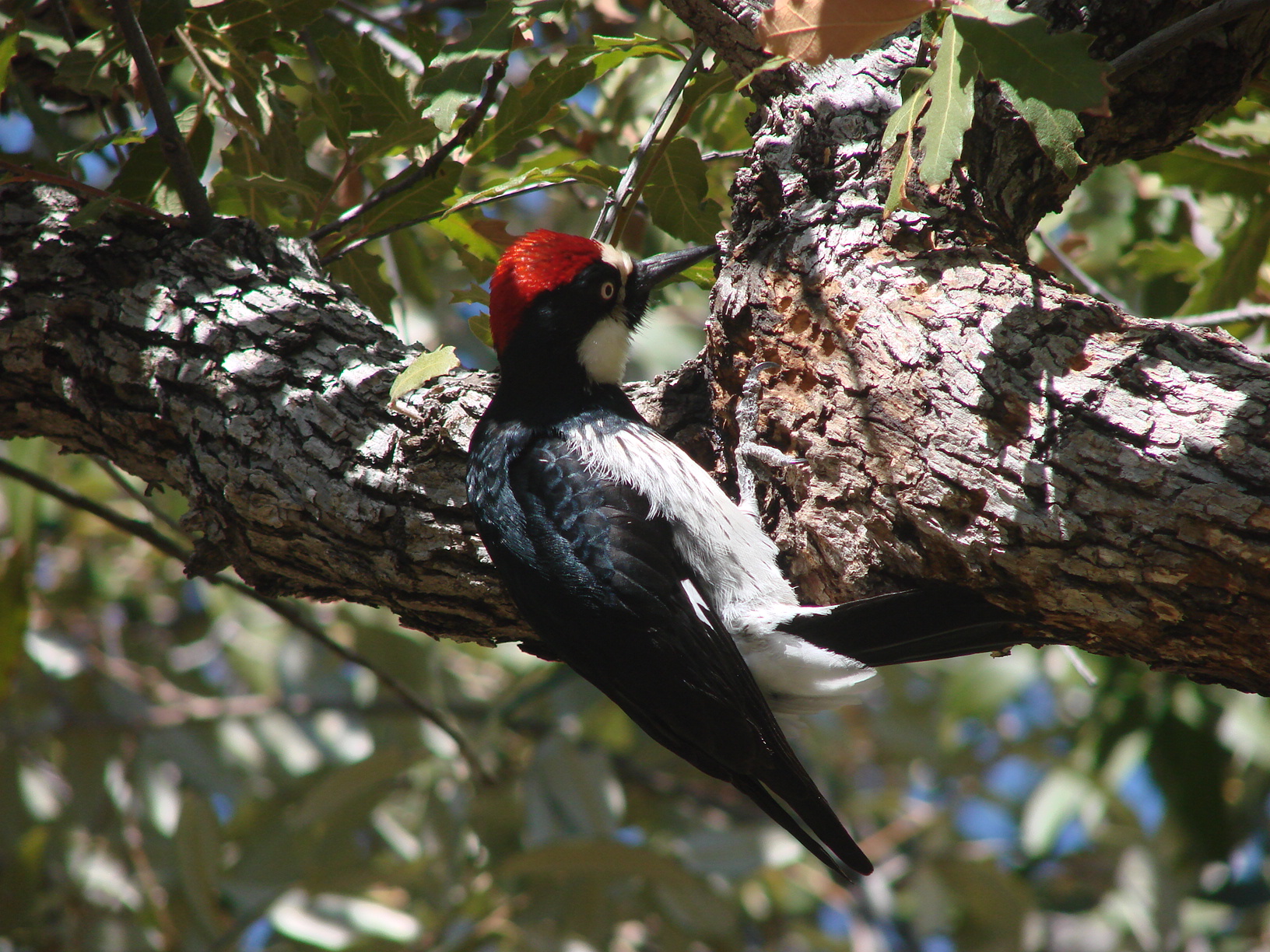
When I started birding my criteria for a 'good' bird were size and immobility--that is to say that I appreciated herons most and warblers least! I have since broadened my perspective and actually enjoy the challenge of finding and identifying numerous warblers. But that still doesn't diminish my joy at easily identifiable birds, and I would have to say the Acorn Woodpecker is one of those.

It's not exactly stationary nor is it particularly big, but its block-like division into black, white and red makes it a hard bird to misidentify in the West (were I in the East, I'd have to at least consider its relatively close relative, Red-Headed Woodpecker, which has even more stringent color blocks, but this is where those range maps in all the field guides come in handy!) To me, Acorn Woodpeckers always look a bit clown-like--maybe that's partly due to their call that seems to say 'wake-up! wake-up! wake-up!'  Or maybe it's the fact that they're so social and are constantly chasing each other around, making me laugh at them.

I think of them as an Arizona bird--but that's just because I've seen them there.  When I read up on them in the Nat Geo's Complete Birds of North America, I found that they are accidental in BC.  This gives me hope that I'll see one in my native land!

Saturday, May 15, 2010

Spotted Towhee


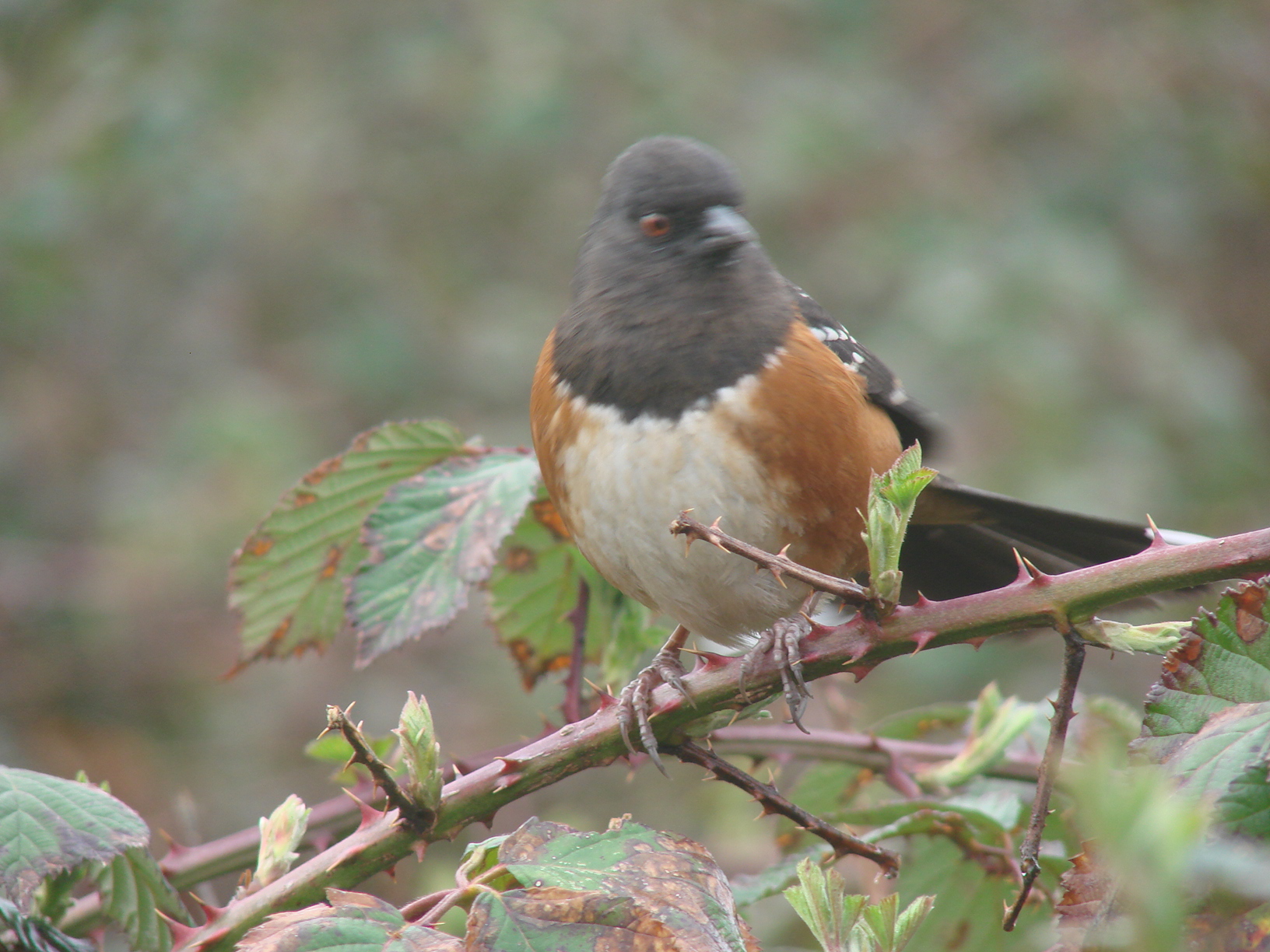
There are many things I love about my 'home and native land'--the way people so many people call out thank you on the bus here in Vancouver comes to mind--but probably one of the best things is that I have a 90% chance of seeing one of a pair of these beauties on my short walk from bus to office in the morning.  There's a hedge just outside my building and invariably a towhee is hopping around in there.  Given the fairly obvious difference in head color (females are brown, males glossy black), I feel quite confident in identifying which of the pair I am seeing.  I keep hoping to see some streaky babies...I can't imagine a better addition to my Towhee sightings!

Unlike most of the birds that pose protracted identification challenges for me, the Spotted Towhee is really quite easy--especially for a sparrow (think of distinguishing Cassin's and Botteri's.... or the various subspecies groups of Dark-eyed Juncos).  Even in flight, Spotted Towhees are recognizable by their big white tail spots, visible from afar.

Their call could potentially be confused with that of the Catbird, but because the latter are very rare here on the West Coast, I assume Spotted Towhee unless proven otherwise (I suppose that is a sign that I am no longer quite a beginner--I have lost the conviction that I am seeing something incredibly rare every day!).

Maybe the ease with which I can identify Spotted Towhees is the true source of my partiality for this large sparrow, but I like to think that it's more due to the bird's good looks and the attention it pays me at the beginning of my day.

Tuesday, May 4, 2010

My Vote for the National Bird of Canada


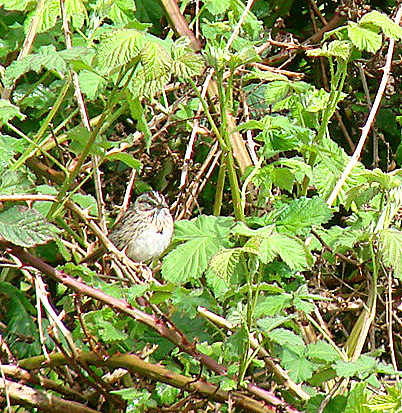
Lincoln's Sparrow was first described in CANADA: in Labrador by Audubon and named for a CANADIAN, Tom Lincoln. Apart from being the most beautiful sparrow in my opinion, Lincoln's is found in all the CANADIAN provinces and territories. Though initially people might hesitate to choose a sparrow as a national bird, Lincoln's Sparrow's distinctive features and beautiful song will, I am sure, encourage people to make the effort to learn one more bird.

Red-tailed Hawk--the current frontrunner--would be a disappointment as the bird for CANADA. It was first described in Jamaica and its scientific name, Buteo jamaicensis, reflects that.

You can add your voice in favor of Lincoln's Sparrow by clicking here.

Saturday, May 1, 2010

Ring-billed Gull


Gulls have always been tricky for me--it seems that they have more plumages than other birds (first/second/third year; juvenile, adult, breeding/non-breeding...) and, frankly, too many of them are white, black and shades of grey.  Heermann's Gull is probably my favourite simply because I have seen them only in breeding plumage when their bills are so red that you can't mistake them for any other gull.
I was pretty good at distinguishing Ring-billed and Herring Gull, too, as they were the ones I saw most in New Jersey.  They were frequently in mixed flocks and  I learned to distinguish them by size comparison (though I admit that I also used leg color despite my usual prejudice against color as an identification criterion).  The Herring Gulls were reliably larger than than the Ring-billeds, in fact they were generally the largest gull around.  Now, however I find myself with a new set of gulls: both Herring and Ring-billed Gulls are not our 'local' species anymore (though they do occur).  You can understand my joy, then, when the other day I saw this fellow--and immediately welcomed it as a long lost friend.  Sadly, this individual is probably not long for this world--he was definitely weak and sickly which allowed my husband to get to close with the camera--but nonetheless, he had the yellowish legs, the ring on the bill and--joy, oh bliss, I discovered that Ring-billed can maintain its position of 'smaller' gull when I compare it to our current local resident: Glaucous-winged Gull.  So, by default, Ring-billed has started me on the way to learning another gull...

Saturday, April 10, 2010

Northern Shrikes

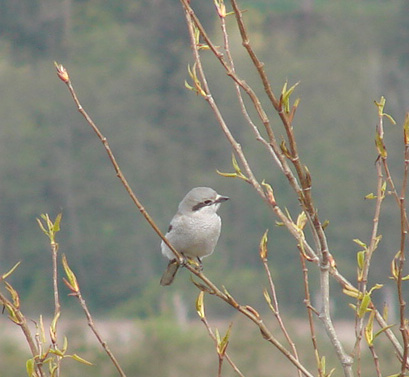
Just when  I thought I'd safely categorized Shrike--versus Northern Mockingbird--I find that I am in the range of Northern Shrike instead of Loggerhead and they're not the same!  At home in Tucson, we're in the range of Loggerhead Shrike--only--but now that we have crossed the international border to the north, we are in the land of Northern Shrike and my learning has to expand, eh?
On a first glance the two Shrikes are pretty similar--and I may be forgiven for enthusiastically calling "Loggerhead" upon our arrival in BC.  The silence from my driving companion--a veteran birder of thirty-five years--assured me that I had made a mistake.  I looked again (in fact I turned around and stopped the car) and observed the bird more closely, that is I stared at the head.  The head appeared to be rounder than usual and the eye mask was rather limited--projecting only behind the eye and not extending across the forehead.  Also, this bird had a white forehead where the Loggerhead has a black one--a distinctive feature, IF you can see it.
So, it's not much to go on--both Shrikes perch in similar locations and both sound--at least to me--similar, but if you pull over and gaze next time you're in the presence of a Shrike, the chances are you'll get it down to species as long as you're in Arizona or British Columbia, and as long as you're not witnessing the first record of Brown Shrike in BC!

Saturday, April 3, 2010

Shrike, are you mocking me?


When I get a nice, up close look at a Loggerhead Shrike such as this one I simply enjoy the view--and am grateful that I am not a lizard, rodent, bug...you get the picture. But when I see said Shrike from a distance, I find it rather easy to be mislead into believing that I am seeing a Northern Mockingbird. Color and pattern are similar--grey with a white wing patch; perch location is similar--tops of trees; and topography is similar--open fields. (Shrikes do appear in urban settings, but far less frequently than Northern Mockingbirds, so I am usually pretty careful before claiming to have seen one in the city).

With experience--and magnification--they really aren't all that similar. Their Gestalt is in fact rather different. While the Northern Mockingbird (and yes, there are southern Mockingbirds--but none are called Southern Mockingbird) is long and slender, the Loggerhead Shrike is long and rather rectangular. In addition, Shrikes in general have large, fat heads while Northern Mockingbirds have rather flatter, smaller ones (all this in comparison to their respective body sizes). The bill shapes, too, continue this distinction as the Shrikes have rather fat, hooked bills while the Northern Mockingbirds have slimmer, thrush-like ones. Lastly, their calls differ: the Loggerhead Shrike has a buzzy one while the Northern Mockingbird sounds more like a 'chack' 'chack'. Most helpful, however, is their song: while the Shrike has a repetitive, buzzy note, the Northern Mockingbird indulges in a wide variety of songs--from mimicking car alarms, to alarm clocks, to mourning doves...you can pretty much count on the fact that if you hear a 'weird' song, you're listening to a Northern Mockingbird. Now a real challenge would be an urban Shrike being imitated by a nearby Northern Mockingbird....I'll post that if it ever happens!