Saturday, November 28, 2009

Red-naped/Red-breasted/Yellow-bellied....

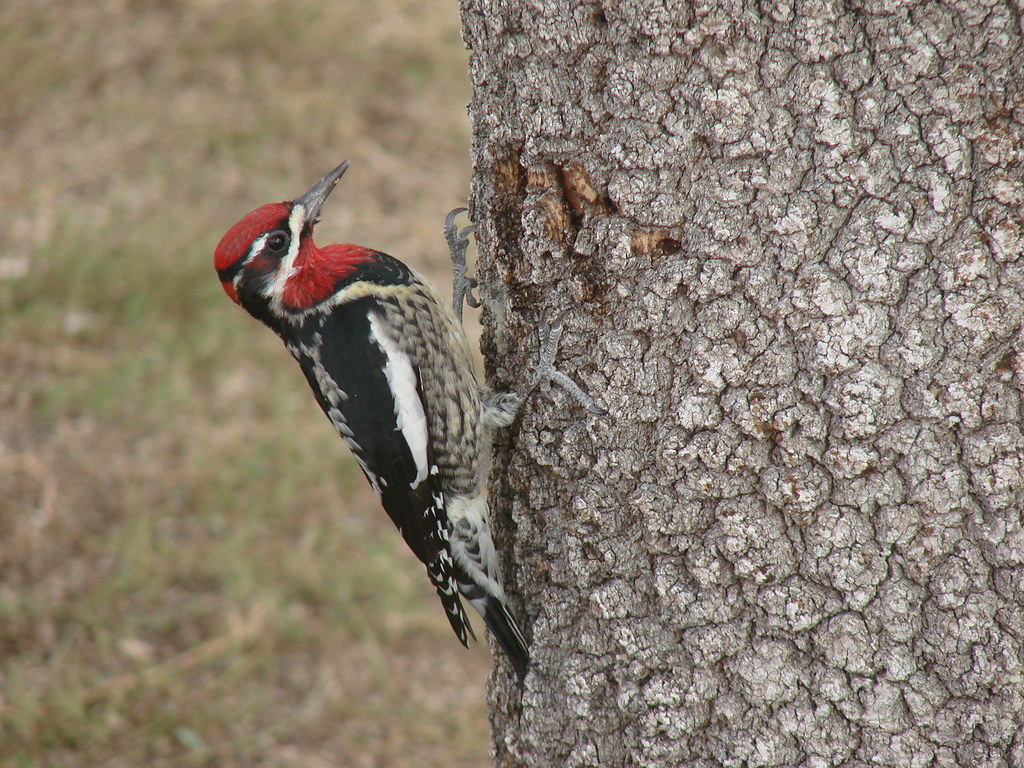
...sapsuckers.  All three used to be lumped as the single species Yellow-bellied Sapsucker.  A  couple of decades ago, the AOU Committee decided to split this bird based on genetic evidence.  Typically, it's relatively easy in the field to distinguish the current three species: the throat pattern of the Red-naped, with its red throat that bleeds through the black lateral throat stripe; the extensive red on the head and breast of the Red-breasted, and the plain nape and irregularly mottled back of the Yellow-bellied.  In addition, of course, range maps will help.  But more and more sapsuckers are showing up out of range and showing intermediate plumages.

All of this makes me wonder whether we shouldn't stop trying to identify weird-looking sapsuckers in the field and instead take inspiration from the old species epithet of the combined Yellow-bellied group: varius.


Saturday, November 21, 2009

Northern Mockingbird


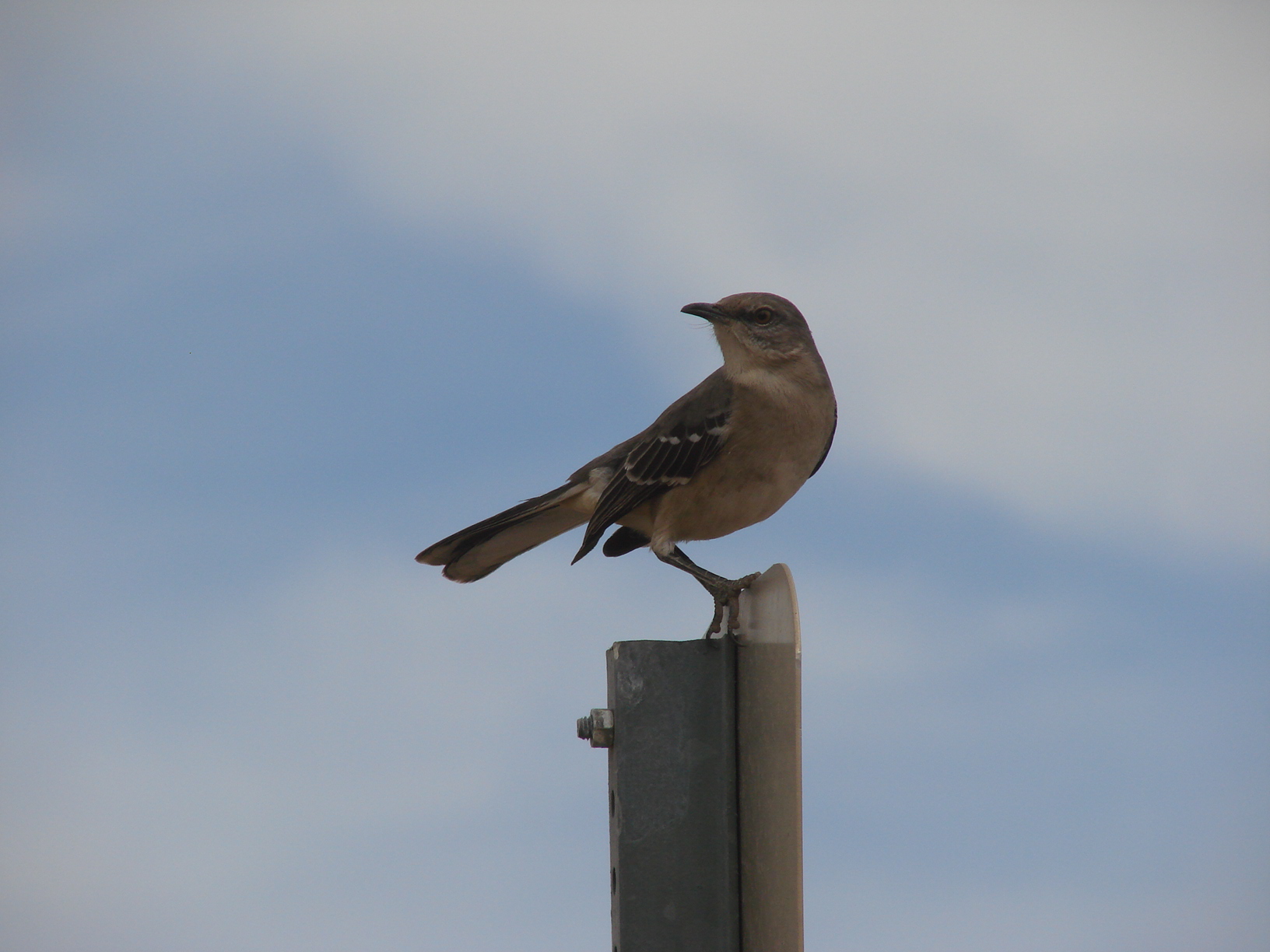
Years ago waking up early one of the first mornings I lived in graduate student housing, I was shocked and stunned to hear a fellow resident's alarm clock persistently ringing.  Was everyone getting up this early--to bird?  I dressed and got ready to leave for my early walk, still hearing the alarm clock.  Oddly, it got louder and louder the closer I got to the outdoors. Only once I was outside and heading towards the woods did I realize my mistake.  No fellow grad student was in sight--but a Northern Mockingbird was perched on a wire opposite my flat and he was singing--or rather ringing--away.

In the intervening years, I have learned that one of the most reliable ways to identify Northern Mockingbirds is, in fact, by their sounds.  If you keep hearing car alarms, alarm clocks, cooking sounds (I'm not kidding) as well as several different birds one after another, the chances are that you're in the presence of a Northern Mockingbird. The classic field marks, of course, are the white patches in the primaries and in the tail, but if the bird is perched (most of the time, in my experience!), you can't see these identification marks.

Perched, usually on top of bushes, the Northern Mockingbirds have a good long tail, a small head, a fairly short and thrush-like bill, and an overall slender look (though they can puff themselves up causing them to look much fatter than they are).  Usually, you can also see the two white wing bars.  In posture they tend to be more horizontal than vertical, and they look alert (rather than sleepy)--probably due to their long legs, though possibly also because they are always on the lookout for their next source of mockery.

Saturday, November 14, 2009

Ugly Duckling


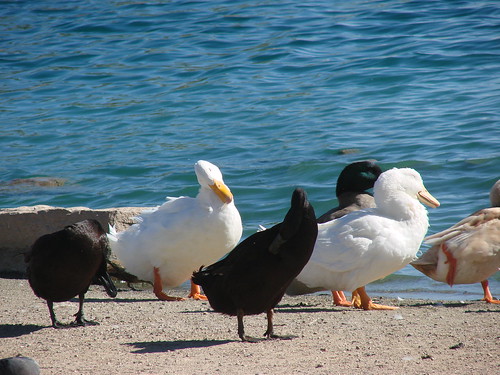
I've always liked the story of the Ugly Duckling.  Maybe it's because I have High School memories of the popular girls or maybe it's because I am ever hopeful that at some point I'll answer that age-old question:  who am I, really?  But at any rate, I have a soft spot for those duck(lings) that many birders ignore or--worse still in my opinion--describe as 'trash birds'.  And Mallards fall among them.

Your classic Drake Mallard in breeding plumage is very easy to identify: its glossy green head, smart white neckline and chocolate-colored breast is unmistakable.  Likewise, the female in breeding plumage has some telltale signs, notably the orange bill with the black center. But there are many Domestic Mallards and they can range in color from pure white to dark black with practically everything in between.  They're usually easy to spot: big, clunky ducks, usually with orange/yellow/green bills.  But I learned a trick to sex these Domestic Mallards:  the breeding males will have the curly-q  feathers at the end of their tales, as seen on the second black Mallard in the picture.  Most people won't look twice at a Mallard, let alone a Domestic one.  But actually, these birds deserve a second glance--just like the Ugly Duckling.

Saturday, November 7, 2009

Fancy Pigeons


To a non-birder the word pigeon generally conjures up images of a multi-colored bird pecking for crumbs in major urban centers: St. Paul's Cathedral in London comes to mind, or the downtown areas of New York.  To a birder those pigeons are Columba livia, aka Rock Doves (or, to really up-to-date birders following the supplements to the AOU checklist Rock Pigeons as of 2003).  But there are many other birds in the Columbidae family; in English they sometimes are called doves, at other times pigeons.

Two of my favourites are Mourning Dove and White-winged Dove (see picture above).  Like the Rock Pigeons, these two are pretty common sights in urban Tucson.  In some ways, I think they're pretty similar: as evidenced by my photo, they choose the same perches, in posture they are both fairly upright and they both have tails that extend far below the wing tips.  Of course, there is the obvious size difference, very obligingly projected by these two birds as they perched next to one another, as well as the clear white wing patches which provide a nice white edge when the White-winged Dove has its wings folded.  But sometimes, you don't get two birds together nor do you get a profile view.

If you're lucky enough to hear the bird you'll easily be able to distinguish the Mourning Dove's slower, really melancholic song from the White-winged's owl-like call.  But what works for me every time is looking more closely at the tail: while both birds have long tails, the Mourning Dove's tail is sharply pointed, a characteristic you can see from any angle.  In contrast, the White-winged Dove's tail is really quite blocky.  If you glimpse the tail from underneath you'll of course also see the dark tail band.  Either bird is really quite beautiful--as are Rock Pigeons--and deserves some appreciation.  All three of these birds are shot in the States, but I prefer to shoot them with the camera.
Sunday, October 11, 2009

Grail Bird?


My husband just came back from Mexico today (the ABA conference in Veracruz) and as soon as he was unpacked (and the laundry machine was going), I eagerly began to examine his photos.  Beautiful, striking birds  appeared before me on the screen. And then along came this bird.  Given the context--exotic birds my spouse got to see and I didn't--and the bird's general shape, especially the cut-off rear end, my initial reaction was "ah, some species of rail that I don't know."  (In my defense the preceding picture was of Gray-necked Woodrail--so I clearly had rails on the brain).  Fortunately, I quickly realized that in fact this was one of my old friends: Great-tailed Grackle, missing its tail feathers.  The eye, too, of course is pale and the bill just doesn't fit a Rail bill.  If I'd been paying better attention, I would have realized that the habitat was more typical of a Grackle than a Rail, too--mowed lawn and concrete.  I know what a Grackle looks like and what a Rail looks like, but thinking about Mexico and expecting something exotic, I merged the two and came up with that centuries old treasure: the Grail -- in bird form, of course!

Saturday, October 3, 2009

How Old are You?


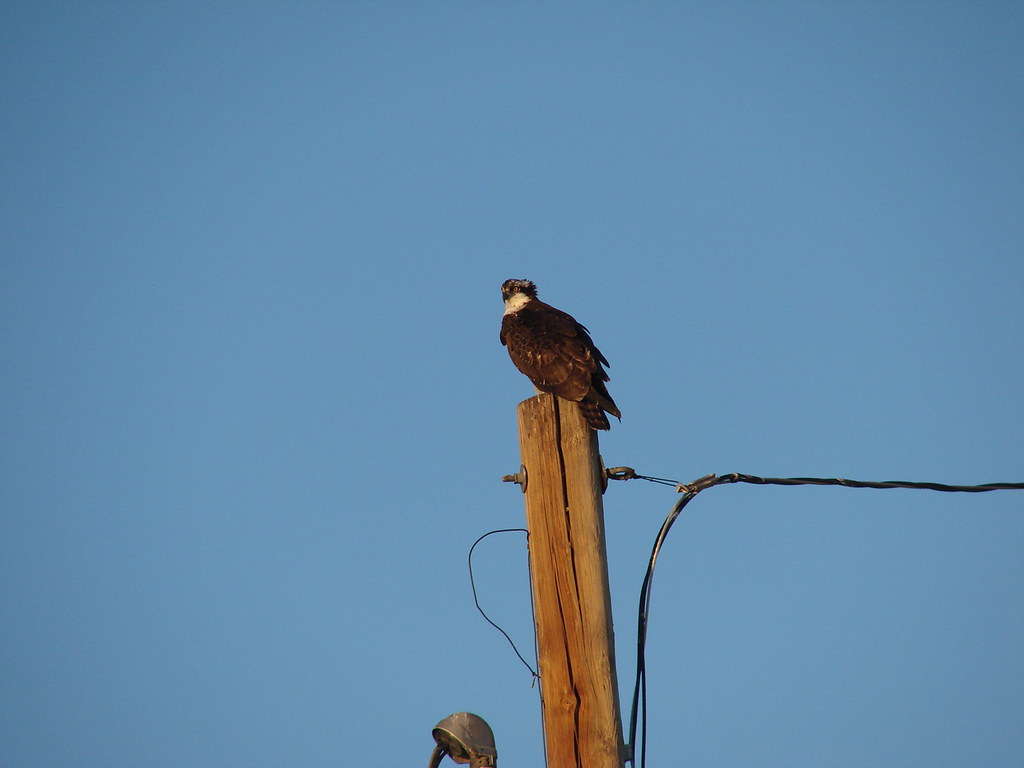
I can now generally identify an Osprey when I see one, though in my earlier years I called plenty of Bald Eagles Ospreys.  There is no rest for the wicked, however, and now I constantly find myself trying to determine the age of the sighted Osprey.


At first study (with binoculars), I looked at the eye color and thought that because the eye was yellowish, this would be an adult (juveniles have orange eyes).  But skeptical as I am of using color as my only identification tool--and because eye color gradually changes over the autumn--I turned to the pattern of the bird.  Juveniles, according to Wheeler, have white tips to all the feathers which gradually wear off as the bird ages.  My bird has a few white tips to go with the yellowish eyes, so it seems to me I have an old juvenile bird.

Still not quite sure, I looked into the migration timing of Ospreys.  It turns out that adults and juveniles don't migrate together; adults leave earlier (beginning in late August and early September), while juveniles are on the road (or the telephone pole) later in the month.  I saw this bird in Utah at the end of September.  That timing supports the 'old juvenile' status I have bestowed on this bird.

I'm never quite sure of age--birds, like people, seem to enjoy hiding their real age.  However, my best guess for this one would be that this white-tipped, yellowish-eyed bird (I haven't mastered sexing Ospreys yet) was on its first migration and thus would be an old juvenile.